
Payments - Four Party Model
The four party model explains how a card payment works by identifiying the four main actors involved in the transaction. From when the card is used to when the merchant recieves the money.
Used in Most open-loop card networks like visa & mastercard.
The four party model and what they do
| Actors | Who | Example |
|---|---|---|
| Card Holder | The customer who initiates the payment using a card | You, me, any shopper using credit/debit card. |
| Merchant | The business that sells the goods/services and wants to receive payment | Starbucks, amazon e-commerce, salon owner |
| Issuer | The cardholder bank that issues the card and decides to approve or decline the payment | Chase, Capital one, Wells fargo |
| Acquirer | The merchant bank or payment processor that helps accept the payment | Stripe, Square |
How money flows in four party model
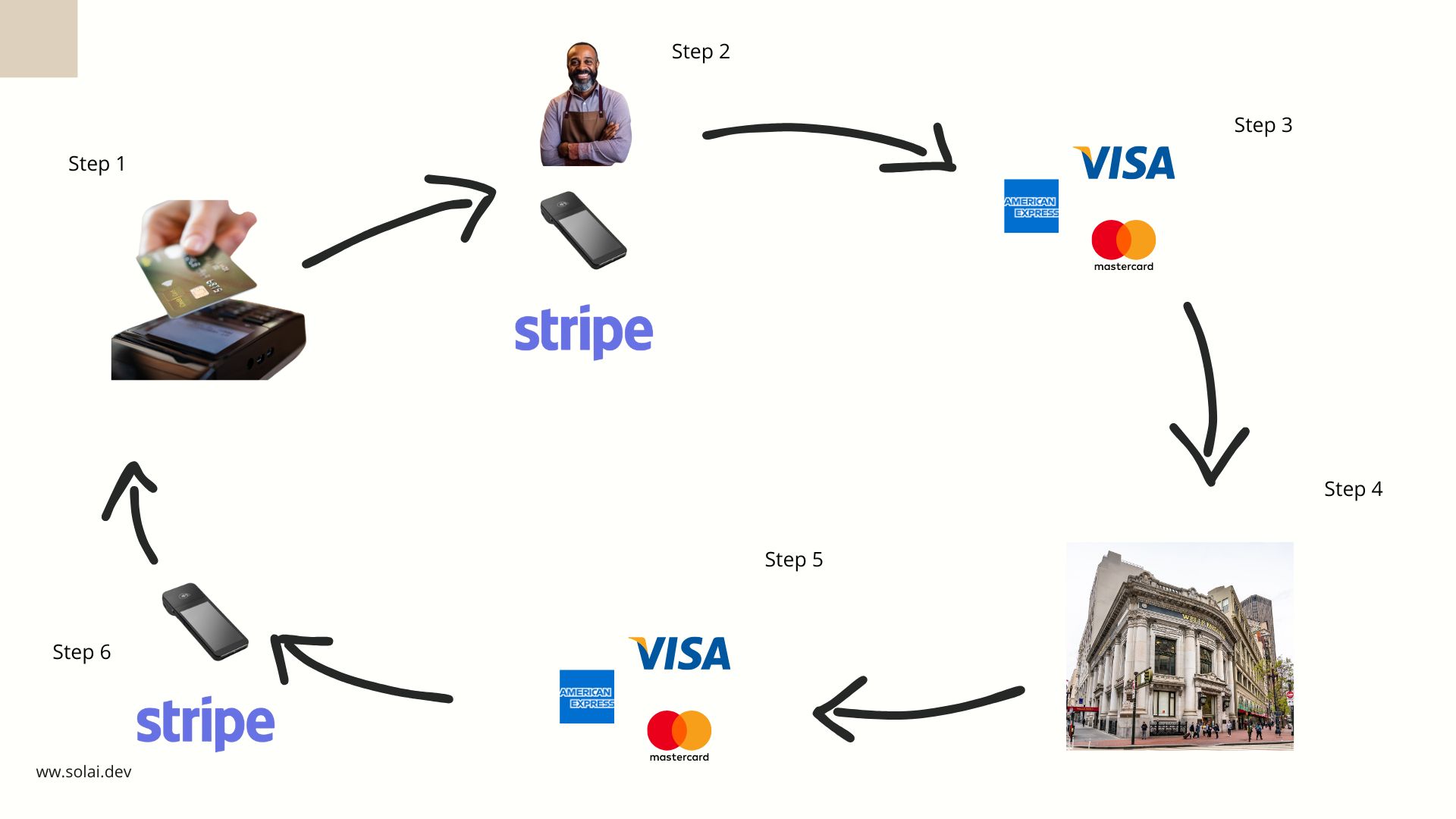
Follow your money through the four parties
The diagram above is the map. The game below lets you walk it: hand over a card at Byte Burger and watch your payment travel out to the store, through the processor and the network, all the way to your bank — and the approval race back. Pay with Visa and four separate companies touch the sale (the open-loop four-party model). Pay with Amex and the network and bank are the same company (a closed loop), so the trip is shorter.
How much money is on your card? Pick a balance — you can’t top it up later.
Tip: order more than your balance and your bank will say no.
Saw the card get approved? That is only half the story. The money has not actually moved yet. Next, follow what happens after you walk out in Life of a Card Transaction.
Want the full picture — interchange, settlement, chargebacks, ACH, and wires — in one sitting? Play Byte Burger Rush, a free browser game that puts all of these concepts together as you run a burger shop through multiple days.